
The Full Circle Project
Reuse, Reduce, Re-Imagine!
The Full Circle Project
Design Research | Branding
Who are we?
The Full Circle Project is a non-profit organization dedicated to fostering a powerful, lifelong connection between children and the environment. Our purpose is to partner with communities to establish immersive, engaging environments where environmental learning and compassionate habits are built through the joy of play.
Why does it matter?
It matters because creating climate-friendly infrastructure and fostering deep environmental compassion is the foundation upon which resilient communities and a sustainable future is built.
Original How Might We Statement
How might we empower communities to lead climate initiatives that inspire individuals to take meaningful action against climate change?
User Personas
“Eco Friendly Mom”
Eco Friendly Mom loves to make switches to organic and eco-friendly products when she can. While she is willing to pay a higher price point for these products, she still loves finding low-cost options. She likes to prioritize organic food products, and loves to shop at farmers markets for ingredients when she has the time. She also prefers to find reusable goods over single-use when she can, but she doesn’t always know about the alternatives.
“Newly Eco Friendly”
Newly Eco Friendly is a junior accountant at a tech company who just recently started switching to more eco-friendly choices. He grew up in a small town, but recently moved to Austin after completing college. He feels good about making more eco-conscious switches, but is having a hard time finding ones that fit his busy schedule and semi-tight budget. He also wants to find a way to get more engaged in his local community.
“Head of the Playground”
Head of the Playground is a fifth grader who has recently been introduced to the aspect of caring for the environment and avoiding wasteful behaviors. In school she learned about recycling and now she is seeing it come into play in real life. She is starting to realize the impact we have on the Earth and how important it is to take care of it. She is a force of boundless curiosity and imagination and she spends most of her time outside. She is fiercely independent and a natural leader among her friends, always the one inventing the rules to new games or leading the charge up the playground slide.
“Environmental Expert”
Environmental Expert is the Deputy Director of the local Spring Lake Education at the Meadows Center for Water and the Environment at Texas State University. She has been part of the Meadows Center team since 2006, helping connect thousands of people each year to the importance of water and environmental conservation. She oversees educational programs at Spring Lake, including field trips, glass-bottom boat tours, and community outreach events that teach visitors about the value of protecting natural resources.
Empathy Map
Says
-
I feel like I can’t make an environmental change on my own
-
I wish I knew how to help save the environment
Thinks
-
I need to teach my kids about recycling
-
I wish there was a way to support a cleaner environment for our whole community
Feels
-
I feel guilty for not helping the environment more.
-
I feel frustrated because the environment is not cared about by enough people/corporations.
Does
-
I try to recycle as much as possible, but often there is not a recycling bin nearby.
Key Survey Data
When asked about recycling habits, we saw a just about 51% of people who recycle frequently, but also about 27% of people responded saying they recycle infrequently with the remainder doing it semi-frequently. This is the first set of data that piqued our interest, and when we dug into why, we saw that a lot of the answers pointed to habits that they developed growing up.
.png)
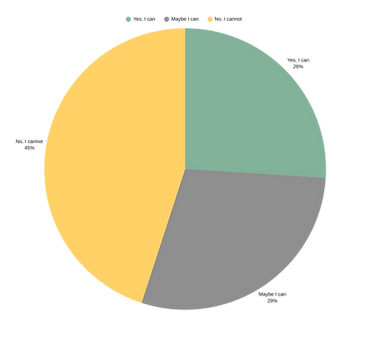
The next survey question that stood out to us was our question about whether or not people felt like they could, as an individual, make a difference in the prevention of climate change. A whopping 45% of responders felt that they couldn’t make an individual difference, and only 26% felt confident that they could. This response helped us shift our thinking to a more community based solution where more people would feel confident in it’s impact.
.png)
Key Interview Data
In our interview process, we got a lot of answers that helped solidify some questions we had, but also posed some new questions for us to consider.
One of those findings was that all of our respondents referenced their childhood and family when asked about their recycling habits. We had one of our respondents, who works in an elementary school, elaborate on how habits built in childhood impact your future and she stated that “It’s because, for either positive or negative, it becomes part of a routine. If they grow up doing that, then it becomes part of their normal”.
Another finding that was helpful in our process to hear was that all of our respondents seemed interested in the idea of a community based project. One of our respondents stated that “The sense of community behind it is encouraging and persuades me to want to be a part of it”. This further pushed us towards a community based solution versus one that just targets individuals.
SHIFT
Our key findings in both the survey and interview data we received led us into a different direction than we anticipated. The data was highlighting to us just how vital it is to build climate conscious values and habits early in age. We decided to shift our focus mainly to our “Head of the Playground” user persona and see how we might be able to target that demographic directly in a way that is educational, engaging, and offers a place for children to make a meaningful connection with the environment.
The answer was right in front of us. A playground!
Our Solution
Our solution was to make a non-profit organization that creates playgrounds out of fully recycled and reclaimed materials that offers an immersive educational experience. By showing children from a young age the positive outcomes of recycling, it allows them to make a meaningful connection to eco-friendly practices and form a deeper understanding of the positive impacts they can make. Most of the materials for this playground would be collected from the community itself, as we would host recycling drives throughout the process to help everyone in the community feel involved in the process.
Updated How Might We Statement
How might we foster an engaging environment for children that helps to build a lifelong sense of connection and compassion with nature and climate friendly habits?
X Y Z Statement
We are researching environmental initiatives through the lens of children’s educational and engagement efforts to help foster more climate conscious habits and values early in life.
Key Partners
One of our key partners is Ballyhoo Plastics - A recycling company based in Corpus Christy, TX that makes and sells plastic resins from recycled materials, which they then sell to companies that melt these little plastic resin pieces down into whatever they’re making. Since we would be providing a large portion of our required material, we would work out a solution that allows us to get a lower rate on our material cost for the resin bits.
Another key partner is Kraftsman Play - A playground and splash park manufacturing company based in Spring, TX. They often work with municipalities, HOA’s, and even schools to implement playgrounds made of post-consumer recycled goods.
Revenue Streams
Since we are planning on opening a series of public parks, we won’t necessarily be generating any form of consistent revenue. However, there does still need to be funding for these parks/ playgrounds. Here is some insight into how we would achieve that.
City/ HOA Funding: Cities frequently use a general fund that is accumulated from taxes to fund public parks and playgrounds. Since we offer a unique, educational, and eco-driven option, we believe that we would be a highly competitive option for cities to go with when they decide to develop a new playground or re-do an old one. HOA’s also often fund their own in-neighborhood parks via funding collected from HOA fees, so we may be able to offer some smaller versions of these playgrounds in neighborhoods as well.
Public Support: Another way we plan to fund these playgrounds is through public support. We plan on running donation drives in the community to collect specific types of recyclable and reusable goods to help the community feel involved in the process of making this playground a reality. That helps to lower our supply cost since we are collecting some of that material on our own.
Fundraising: Lastly, we can also collect funding via community fundraising. While most people likely wouldn’t donate to fund just an ordinary playground, ours offers something unique. We believe that there would be community support to implement our playgrounds, and if there aren’t the funds from the city to implement it, then communities could also fundraise to get our playgrounds in their area.
Channel Phases
Awareness: We plan to raise awareness for our organization through collecting the recyclable materials from the community, as well as through educational signage and an informational website.
Evaluation: We work with local Texas recycling companies to make sure that every bit of waste gets recycled, ensuring that the community has a positive and documented impact on climate change.
Purchase: While customers aren’t purchasing anything from us they are able to donate if they wish though, but it’s not required. Donations will serve to help fund further projects in lower income areas that may not have the funds to implement one of our parks themselves. They will also go to help fund future projects we may expand to.
Delivery: We offer a finished product to a community using the recycling we’ve collected from them, installing the playground at no direct cost to them, and providing a safe space for children to play, engage with nature, and learn about climate change actions.
After Sales: We will maintain post-service customer support by making sure the playgrounds we install remains safe, clean, and in good condition by offering free repairs for reasonable damages.
Visual Research

Branding
Brand Voice
The Full Circle Project speaks with a dedicated and trustworthy voice that believes that compassion begins with play. We collaborate with communities to establish immersive, engaging spaces that serve as dynamic outdoor classrooms, ensuring that the critical, lifelong link between children and the natural world is secured through joy and discovery.
Brand Pillars
Environmental Stewardship
We strive to uphold ethical resource management and closed-loop design. Our parks are tangible proof that waste is a resource, and that community efforts can make a meaningful impact on climate change prevention.
Foundational Childhood Connections
We are driven by the belief that lifelong environmental compassion begins in childhood and is best built through active play and discovery. We strive to create environments that feel natural and engaging, sparking the curiosity necessary for children to build an undeniable, lasting bond with the planet.
Accessible Education & Engagement
We transform public spaces into dynamic, hands-on outdoor classrooms where learning to care for and protect the environment goes hand in hand with play and fun. We utilize clear, compelling graphics and engaging tactile elements to make learning effortless, turning play into a platform for climate literacy.
Community Resilience & Partnership
The Full Circle Project serves as a catalyst for communities to be able to make meaningful contributions in the fight against climate change. Involving the community in this process establishes a deeper connection with our service and also encourages further recycling practices.
Tagline
Reduce, Reuse, Re-Imagine!
Logo


Type Palette


Color Palette
#1A2836
rgb(26,40,54)
cmyk(52,26,0,79)
#1ABC9C
rgb(26,188,156)
cmyk(86,0,17,26)
#FF6B6B
rgb(255,107,107)
cmyk(0,58,58,0)
#A8E61C
rgb(168,230,28)
cmyk(27,0,88,10)
#FFC300
rgb(255,195,0)
cmyk(0,24,100,0)
#8D5B4C
rgb(141,91,76)
cmyk(0,35,46,45)
Outcomes


